How to Find the Channel Length Modulation Parameter From Vi Graph

Welcome to EDAboard.com
Welcome to our site! EDAboard.com is an international Electronics Discussion Forum focused on EDA software, circuits, schematics, books, theory, papers, asic, pld, 8051, DSP, Network, RF, Analog Design, PCB, Service Manuals... and a whole lot more! To participate you need to register. Registration is free. Click here to register now.
- Forums
- Analog Design
- Analog Integrated Circuit (IC) Design, Layout and
You should upgrade or use an alternative browser.
can get the value of lambda (channel modulation) from IV curve?
- Thread starter aindejeje
- Start date
- Status
- Not open for further replies.
- #1
Can we estimate the value of lambda from IV curve?
Is the slope of the IV curve represent lambda?
Thanks.
Attachments
-
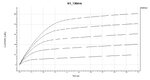 IDVD_130nm_WL(2)_40100(15pc).jpg
- #2

- Joined
- Dec 22, 2009
- Messages
- 155
- Helped
- 32
- Reputation
- 64
- Reaction score
- 28
- Trophy points
- 1,308
- Location
- Florence (ITALY)
- Activity points
- 2,384
- #3
del(I)/del(V) - mho (transconductance)
whereas lambda = V (power -1)
lambda = del(L) / VE x L
but why slope is used to estimate lambda?
i don't get it.
- #4
- Joined
- Dec 22, 2009
- Messages
- 155
- Helped
- 32
- Reputation
- 64
- Reaction score
- 28
- Trophy points
- 1,308
- Location
- Florence (ITALY)
- Activity points
- 2,384
the MOS current is:
Id=unCox/2*W/L*(VGS-VTH)^2*(1+lambda*VDS)
so, if u differentiate Id with respect to VDS, you obtain lambda*Id.
the derivative of Id(Vds) to VDS is the slope of Id(VDS). You divide it by Id and you have lambda for a given bias point.
- #5
Idm = Id with channel modulation effect
Id = Id without channel modulation effect
therefore
del(Idm)/del(VDS) = slope = lambda x Id
right?
to get the lambda, divide slope with Id,
where Id is the value when VDS=VGS-VT
right?
- #6
- Joined
- Dec 22, 2009
- Messages
- 155
- Helped
- 32
- Reputation
- 64
- Reaction score
- 28
- Trophy points
- 1,308
- Location
- Florence (ITALY)
- Activity points
- 2,384
- #7

- Joined
- Apr 19, 2011
- Messages
- 19
- Helped
- 1
- Reputation
- 2
- Reaction score
- 1
- Trophy points
- 1,283
- Location
- San Jose State
- Activity points
- 1,373
- #8
- Joined
- Dec 22, 2009
- Messages
- 155
- Helped
- 32
- Reputation
- 64
- Reaction score
- 28
- Trophy points
- 1,308
- Location
- Florence (ITALY)
- Activity points
- 2,384
There is another way you can find lambada value.If you use cadence.Do ac analysis and if you see model parameters their should be lambada value.
i think this is only for low level models. in higher complexity models, lambda is not present, and the channel length modulation is described in more complicated and accurated ways.
- #9
- Joined
- Apr 19, 2011
- Messages
- 19
- Helped
- 1
- Reputation
- 2
- Reaction score
- 1
- Trophy points
- 1,283
- Location
- San Jose State
- Activity points
- 1,373
How you differentiate low level and higher complexity model regarding lambda??i think this is only for low level models. in higher complexity models, lambda is not present, and the channel length modulation is described in more complicated and accurated ways.
- #10
dgnani
Advanced Member level 1

- Joined
- Jul 25, 2009
- Messages
- 425
- Helped
- 160
- Reputation
- 322
- Reaction score
- 152
- Trophy points
- 1,323
- Location
- USA
- Activity points
- 4,007
Hi.
Can we estimate the value of lambda from IV curve?
Is the slope of the IV curve represent lambda?
Thanks.
Assuming you can use a spice level 1 model in a 130nm design (L has to be far from minimum) then lambda is the inverse of the Early voltage, which in turns is defined as the (absolute) value where the tangent to the IV vs Vds curve in the saturation region crosses the Vds axis
Given a linear fit of the IV curve in saturation, say, Id=m Vds+q (m is the slope/derivative in saturation) the Early voltage is
Ve=-q/m
that is
lamba=-m/q
The attached drawing should help clarifying: the red lines converge (according to the spice 1 model) to the same point on voltage axis, that point is the Early voltage.
---------- Post added at 19:48 ---------- Previous post was at 19:45 ----------
How you differentiate low level and higher complexity model regarding lambda??
In ultra deep submicron processes, other second order effects such as DIBL and velocity saturation will dominate over channel length modulation. A better model to do hand calculation in those cases is gm/Id
Attachments
- Eda Forum 210677 reply.pdf
- #11
- Joined
- Dec 22, 2009
- Messages
- 155
- Helped
- 32
- Reputation
- 64
- Reaction score
- 28
- Trophy points
- 1,308
- Location
- Florence (ITALY)
- Activity points
- 2,384
How you differentiate low level and higher complexity model regarding lambda??
check bsim3v3 or mos9 manuals for example.
- #12
- Joined
- Apr 19, 2011
- Messages
- 19
- Helped
- 1
- Reputation
- 2
- Reaction score
- 1
- Trophy points
- 1,283
- Location
- San Jose State
- Activity points
- 1,373
got it you are right but you can find it my way too.i tried it.but might be hand calculation is better.Thank you.check bsim3v3 or mos9 manuals for example.
- Status
- Not open for further replies.
- Forums
- Analog Design
- Analog Integrated Circuit (IC) Design, Layout and
- This site uses cookies to help personalise content, tailor your experience and to keep you logged in if you register.
By continuing to use this site, you are consenting to our use of cookies.
How to Find the Channel Length Modulation Parameter From Vi Graph
Source: https://www.edaboard.com/threads/can-get-the-value-of-lambda-channel-modulation-from-iv-curve.210677/
0 Response to "How to Find the Channel Length Modulation Parameter From Vi Graph"
Post a Comment